Not sure which vaping style suits you? Whether you're switching from cigarettes or just exploring your options, understanding MTL vaping, DTL vaping, and RDL vaping is the first step. Each style delivers a different airflow, a different amount of vapour, and a noticeably different throat hit — and choosing the wrong one is one of the most common reasons new vapers give up too early.
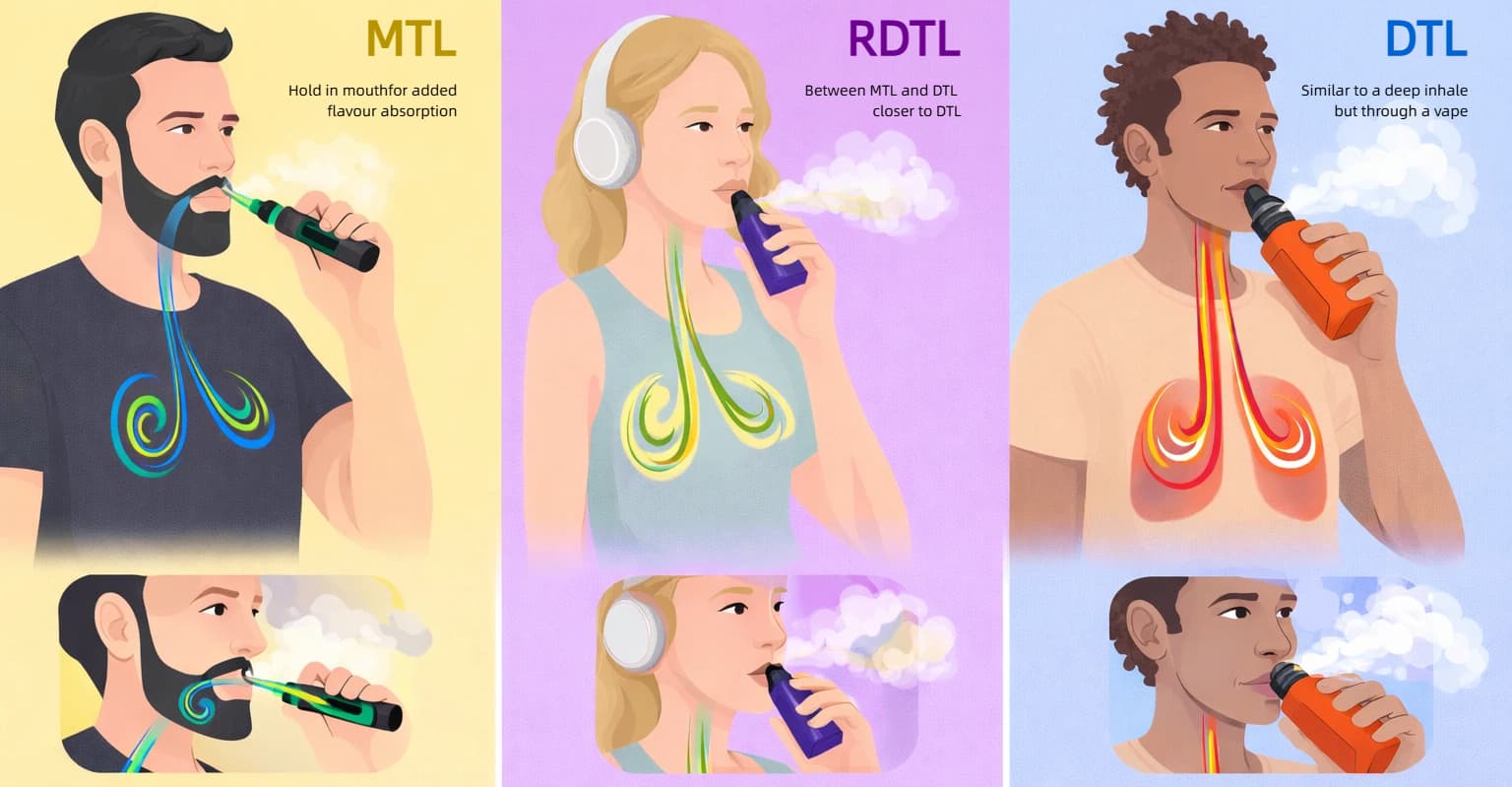
Mouth-to-Lung — tight draw, high nicotine, cigarette-like feel
Restricted Direct-to-Lung — balanced vapour, flavour & throat hit
Direct-to-Lung — open draw, big
clouds, low nicotine
What Are the Main Vaping Inhale Styles?
Every vape kit works around one core principle: how you pull air through the device. That single choice shapes everything — from how much vapour you produce to how strong the nicotine hit feels. There are three recognised inhale styles used across the UK vaping market today:
- MTL (Mouth-to-Lung) — draw vapour into your mouth first, then inhale into your lungs. Closely mirrors the action of smoking a cigarette.
- DTL (Direct-to-Lung) — inhale vapour straight into your lungs in one open, deep draw. Produces large clouds.
- RDL (Restricted Direct-to-Lung) — sits between MTL and DTL, offering a slightly more open airflow without the full lung-hit of sub-ohm DTL.
Airflow determines whether a device is designed for MTL, RDL, or DTL use. Tight airflow mimics the resistance of a cigarette; wide-open airflow allows the large draws needed for cloud production. Getting this right is far more important than most beginners realise.
MTL vs RDL vs DTL: Quick Comparison
← Scroll to see full table| Inhale Style | Airflow Type | Coil Resistance | VG/PG Ratio | Nicotine Strength | Vapour Production | Best Suited For |
|---|---|---|---|---|---|---|
| MTL | Tight / restricted | 0.8Ω – 1.2Ω | 50/50 | 10–20mg (salts) / 6–18mg (freebase) | Low to medium | Smokers switching, discreet vapers |
| RDL | Semi-restricted | 0.5Ω – 0.8Ω | 60/40 or 70/30 VG | 3–10mg | Medium to high | Vapers stepping up from MTL |
| DTL | Wide open / free | 0.15Ω – 0.4Ω | 70VG+ (often 80/20) | 0–6mg | High (large clouds) | Experienced vapers, cloud chasers |
What Is MTL Vaping?
Mouth-to-LungMTL vaping replicates the draw of a traditional cigarette almost exactly. You pull vapour into your mouth, hold it briefly, then inhale into your lungs. The airflow on an MTL device is deliberately restricted, which creates the familiar resistance that former smokers find comfortable and reassuring.
Because the airflow is tight, MTL setups work well with higher nicotine concentrations. Nicotine salts at 10–20mg are the most popular choice for MTL users in the UK — they deliver a satisfying hit without the harshness that high-strength freebase nicotine can cause. Many vapers pair MTL devices with refillable pod kits and 50/50 VG/PG e-liquids for consistent flavour and easy maintenance.
MTL Vaping at a Glance
- Closely mirrors the action of smoking — easier transition from cigarettes
- Produces modest vapour — discreet for public or office use
- Strong throat hit at higher nicotine levels
- Low power draw means longer battery life per charge
- Ideal with 50/50 e-liquids and nicotine salt formulas
Popular MTL Devices in the UK
What Is DTL Vaping?
Direct-to-LungDTL vaping (also called direct lung or sub-ohm vaping) involves inhaling vapour straight into your lungs in one smooth, uninterrupted draw — similar to taking a deep breath. The airflow on a DTL device is wide open, which allows large volumes of warm vapour to pass through quickly.
DTL setups use low-resistance mesh coils (typically 0.15Ω–0.4Ω) and run at higher wattages — anywhere from 40W to 100W+. This combination produces dense clouds and intensifies flavour at the cost of higher e-liquid consumption. Because the vapour intake is so high, DTL vaping requires low-nicotine e-liquids; using a 20mg nicotine salt in a DTL device would be an unpleasant experience.
DTL Vaping at a Glance
- Maximum vapour production — the choice for cloud enthusiasts
- Rich, warm flavour from high-VG e-liquids (70VG+)
- Requires low nicotine: typically 0–6mg freebase
- Uses more e-liquid and battery power than MTL or RDL
- Not recommended for recent ex-smokers with high nicotine dependency
Popular DTL Devices in the UK
What Is RDL (Restricted Direct-to-Lung) Vaping?
Restricted Direct-to-LungRDL vaping (restricted direct-to-lung, sometimes written RDTL) fills the space between MTL and DTL. The airflow is more open than a tight MTL device but not as unrestricted as a full sub-ohm DTL setup. You still inhale directly into the lungs, but the draw has a noticeable resistance that keeps the experience manageable.
RDL strikes a practical balance: more vapour and flavour depth than MTL, without the cloud volume and low-nicotine requirements of DTL. Vapers who have grown comfortable with MTL and want to explore more output — or those who want decent flavour at moderate nicotine levels — tend to settle naturally into RDL as their long-term style.
RDL Vaping at a Glance
- Good balance of vapour production and flavour intensity
- Works well with 3–10mg e-liquids — bridging the gap between high-nic MTL and low-nic DTL
- Coil resistance typically 0.5Ω–0.8Ω
- Compatible with 60/40 or 70/30 VG/PG e-liquids
- A genuine stepping stone for vapers evolving from MTL
Popular RDL Devices in the UK
How Airflow Affects Your Vaping Experience
Airflow is the single biggest variable in how a vape kit performs. Adjusting the airflow ring on a device is not just cosmetic — it changes the temperature, density, and feel of every draw.
- Tight airflow (MTL): Warmer, more concentrated vapour. Flavour is punchy and direct. Throat hit is pronounced, particularly with freebase nicotine above 6mg.
- Semi-restricted airflow (RDL): Cooler vapour, slightly more cloud, flavour remains clear. Throat hit is softer, which suits mid-range nicotine concentrations.
- Wide-open airflow (DTL): Cooler, airier vapour in large volumes. Flavour spreads across the palate rather than hitting sharply. Throat hit is minimal even at 3mg.
If you close down the airflow on a DTL device, you move it towards RDL territory. Many modern vape kits include adjustable airflow precisely for this reason — one device can sometimes serve both RDL and light DTL purposes depending on user preference.
Coil Resistance Explained
Coil resistance (measured in ohms, Ω) directly affects how quickly the coil heats up and how much vapour it produces. Here's how resistance maps to each vaping style:
← Scroll to see full table| Vaping Style | Coil Resistance | Typical Wattage | Vapour Temperature |
|---|---|---|---|
| MTL | 0.8Ω – 1.2Ω | 8W – 20W | Warmer |
| RDL | 0.5Ω – 0.8Ω | 20W – 40W | Medium-warm |
| DTL | 0.15Ω – 0.4Ω | 40W – 100W+ | Cooler (high airflow) |
Sub-ohm coils (below 1Ω) are commonly associated with RDL and DTL use, while coils at 1Ω and above are almost exclusively MTL territory. Using a high-resistance MTL coil in a DTL device — or vice versa — will either produce no vapour or burn the coil out quickly.
Choosing the Right E-Liquid for Each Style
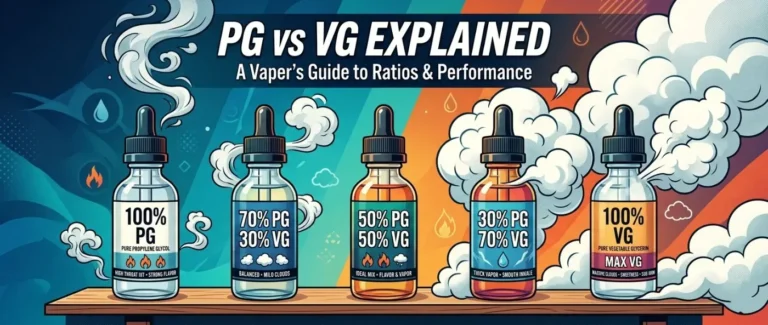
The VG (vegetable glycerine) to PG (propylene glycol) ratio in your e-liquid matters as much as the device you choose. Getting this wrong is a common source of frustration for beginners.
- MTL — 50/50 VG/PG: PG carries flavour and produces the throat hit MTL users expect. A 50/50 blend flows easily through tight MTL coils without flooding or clogging. Works well with both freebase nicotine and nicotine salts.
- RDL — 60/40 or 70/30 VG/PG: Slightly higher VG increases vapour density while keeping the liquid thin enough for RDL coils. Nicotine strengths of 3–10mg are typical.
- DTL — 70VG+ (often 80/20 or Max VG): High-VG liquids produce the thick, smooth clouds DTL is known for. Anything below 70VG will feel thin and sharp in a DTL setup. Keep nicotine at 0–6mg to avoid an uncomfortably harsh hit.
Which Vaping Style Is Best for Beginners?
For most people moving from cigarettes to vaping, MTL is the logical starting point. The restricted draw feels familiar, and the higher nicotine compatibility means you can manage cravings without needing to vape constantly.
- Heavy smokers (20+ cigarettes/day): Start with MTL + 20mg nicotine salt. The throat hit is close enough to a cigarette to ease the transition.
- Light to moderate smokers: MTL with 10–12mg freebase or nicotine salt works well. Some users adapt quickly and move to RDL within a few months.
- Vapers curious about bigger clouds: RDL offers a noticeable step up without the dramatic shift of going straight to DTL. It's a sensible intermediate stage.
- Experienced vapers / cloud hobbyists: DTL at low nicotine becomes the natural destination once you're no longer managing nicotine dependency.
Pros and Cons at a Glance
🔵 MTL
- ✔ Familiar draw for smokers
- ✔ Works with high-nic salts
- ✔ Discreet vapour output
- ✔ Efficient battery use
- ✔ Lower e-liquid consumption
- ✘ Limited flavour complexity
- ✘ Small cloud production
🟢 RDL
- ✔ Better flavour than MTL
- ✔ More vapour without going full DTL
- ✔ Mid-range nic options available
- ✔ Smooth transition device
- ✘ Fewer dedicated RDL kits
- ✘ Less throat hit than MTL
🔴 DTL
- ✔ Maximum vapour and flavour
- ✔ Wide range of coil and mod options
- ✔ Ideal for flavour enthusiasts
- ✘ Must use low nicotine only
- ✘ Not discreet
- ✘ Higher running costs
- ✘ Not suitable for beginners
Common Beginner Mistakes to Avoid
- Using the wrong coil resistance: Fitting a 0.2Ω DTL coil into an MTL-style device — or expecting a 1.0Ω MTL coil to work in a DTL tank — either burns the coil or produces almost no vapour.
- Mismatching VG/PG ratio: Running a high-VG (80/20) liquid through a tight MTL coil causes flooding, gurgling, and coil degradation. Use 50/50 in MTL devices.
- Ignoring airflow settings: Many beginners leave the airflow fully open regardless of device type. On an MTL pod, closing the airflow ring down significantly improves both throat hit and flavour.
- Using high nicotine in a DTL setup: 20mg salt in a sub-ohm DTL tank can cause nicotine sickness. Always drop to 3mg or 6mg before using DTL equipment.
- Priming coils incorrectly: Not soaking a new coil with e-liquid for 5–10 minutes before first use is the quickest way to burn out a coil and ruin the flavour.
How to Choose the Right Vape Kit for Your Style
Once you know which inhale style suits you, matching it to the right hardware becomes much simpler. Here are the key things to look at:
- Airflow control: Look for a kit with an adjustable airflow ring if you're unsure which style you prefer. Fixed airflow devices work fine once you're confident in your preference.
- Coil compatibility: Confirm the kit supports coils in the resistance range for your style (MTL: 0.8Ω+, RDL: 0.5–0.8Ω, DTL: below 0.4Ω).
- Battery capacity: MTL pod kits with 500–1000mAh batteries suit light to moderate users. DTL mods require 2000mAh+ — ideally dual 18650 batteries for all-day use.
- Refillable systems: Refillable pod kits are the most practical and cost-effective choice for MTL and RDL use in the UK. They're also fully compatible with nicotine salt e-liquids and meet TPD-compliant 2ml tank requirements.
- Starter vs advanced kits: Beginners should look for kits with fixed wattage or guided wattage suggestions printed on the coil itself. Variable wattage mods are better suited to users who understand ohm's law basics.
What Vapers Actually Experience
Many vapers report that the first week of switching from cigarettes to an MTL kit feels surprisingly natural — particularly when using nicotine salt at 20mg. The throat hit is present, the draw resistance feels right, and the nicotine delivery is fast enough to curb cravings. The vapour output is modest, which is actually a feature rather than a drawback for anyone wanting to use a vape at work or in public.
After testing several refillable pod kits across different airflow configurations, it becomes clear that airflow adjustability is genuinely useful during the first few months of vaping. Moving from a tight MTL setting to a semi-restricted RDL position on the same device allows users to experiment without buying new hardware.
DTL vaping tends to be a later discovery rather than a starting point. The experience is satisfying on its own terms — rich, full vapour, excellent flavour from premium high-VG liquids — but it's a different activity to smoking, and that distinction matters for anyone using vaping as a cessation tool.
Frequently Asked Questions
Is MTL vaping better for beginners?
For most people switching from cigarettes, yes. The restricted draw, familiar throat hit, and compatibility with higher nicotine strengths make MTL the easiest transition. It closely replicates the physical habit of smoking, which helps during the early stages of cessation.
Can you use nicotine salts with DTL vaping?
It's not recommended. Nicotine salts at 10–20mg are designed for MTL devices. In a DTL kit, the volume of vapour per draw means you absorb far more nicotine than intended, which can cause nausea or dizziness. Use freebase nicotine at 0–6mg for DTL setups.
What coil resistance works best for MTL vaping?
Coils between 0.8Ω and 1.2Ω are ideal for MTL use. They heat gently at low wattages (8–20W), produce warm and concentrated vapour, and deliver a reliable throat hit at higher nicotine strengths.
Is RDL a good middle ground between MTL and DTL?
Yes, and many long-term vapers settle on RDL permanently. It offers noticeably more vapour and flavour depth than MTL without the high e-liquid consumption and low-nicotine requirements of DTL. It's particularly well-suited to vapers who have reduced their nicotine intake to 5–10mg.
Why does DTL produce more vapour than MTL?
DTL devices use low-resistance coils (sub-ohm) running at high wattages with wide-open airflow. This combination heats a larger coil surface area faster, vaporising more e-liquid per draw. High-VG liquids amplify this effect, producing the thick clouds associated with sub-ohm vaping.
Can one vape kit support both MTL and RDL?
Many modern pod kits — such as the OXVA Xlim SE 2 and Aspire Flexus Peak — include adjustable airflow and multiple compatible coil resistances. Fitting a 1.0Ω coil and closing the airflow gives MTL performance; swapping to a 0.6Ω coil and opening the airflow halfway shifts the same device into RDL range.
How does airflow affect flavour in vaping?
Tighter airflow concentrates vapour, making flavours taste more intense and defined — ideal for fruit, menthol, and tobacco profiles. Wide-open airflow dilutes the vapour slightly, spreading the flavour more broadly across the palate. Complex dessert or cream flavours often perform well in RDL and DTL setups because of this.
What VG/PG ratio should I use for nicotine salt e-liquids?
Most nicotine salt e-liquids in the UK are formulated at 50/50 VG/PG, making them ideal for MTL coils and refillable pod kits. Some brands offer 60/40 options for slight RDL compatibility, but anything above 70VG is too thick for most salt nic coils and will cause flooding.
Conclusion: Which Style Should You Choose?
There's no single correct answer — the right vaping style depends on where you're starting from and what you want to get out of the experience.
- MTL is the right starting point for smokers switching to vaping. The draw feels familiar, nicotine salt compatibility is excellent, and the discreet vapour output suits everyday life in the UK.
- RDL is the sensible next step once nicotine dependency decreases. It delivers improved flavour, more vapour, and a satisfying vape without requiring the full commitment of a sub-ohm DTL setup.
- DTL is for vapers who have moved past dependency management and want to explore vaping as a hobby — maximising cloud production, flavour intensity, and hardware experimentation at low nicotine levels.
Start where it's most comfortable, learn your device, and adjust from there. The hardware and e-liquid choices are wide enough in the UK market that there's no need to rush through the styles.