PG vs VG Explained: what VG/PG ratios really change in your vape
If you\'re choosing e-liquid for a pod kit, a classic MTL tank, or a sub‑ohm setup, your PG/VG ratio decides more than “clouds vs flavour”. It affects throat hit, wicking speed, leaks, dry hits, and which coils behave nicely with your liquid.
PG is a thin e‑liquid base that carries flavour well and gives a stronger throat hit, while VG is thicker and makes smoother vapour with denser clouds. Your VG/PG ratio also changes how fast liquid wicks, how likely you are to get leaks or dry hits, and which vape kit styles work best.
Basics
PG vs VG meaning: what those letters on your e‑liquid bottle tell you
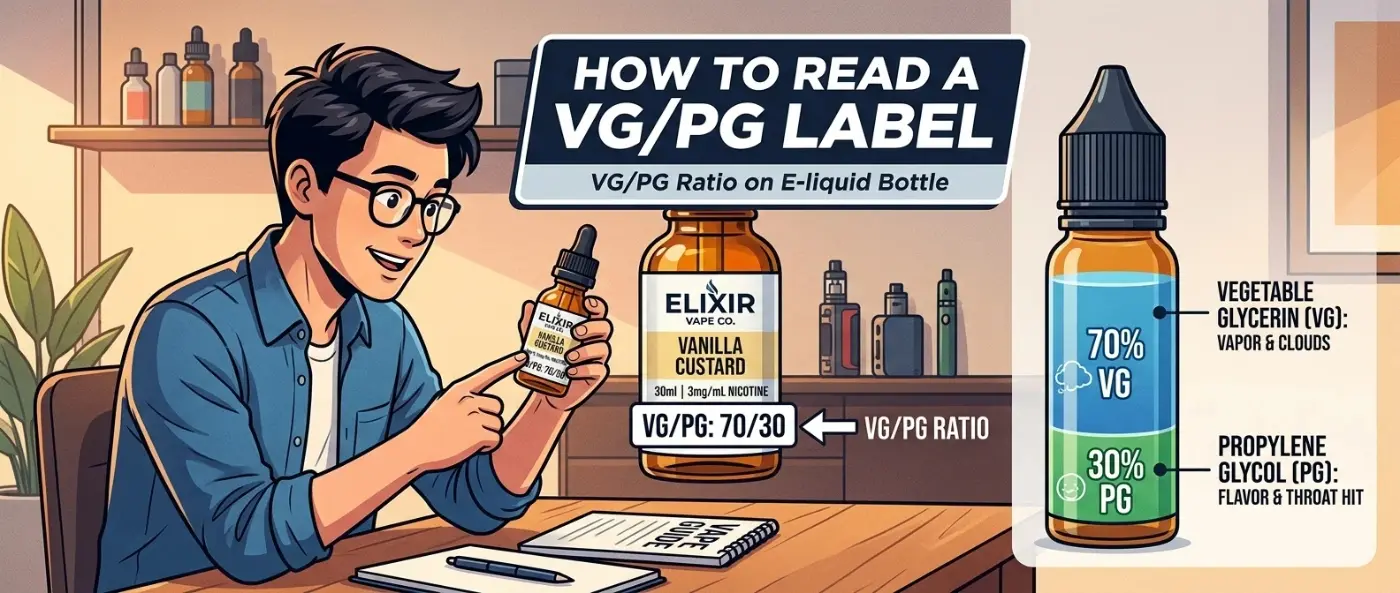
Most UK e‑liquids use two base liquids: PG (propylene glycol) and VG (vegetable glycerine). The ratio (like 50/50 or 70/30) is the percentage mix of VG and PG.
In day-to-day use, that ratio mainly changes three things: how it feels in your throat, how strong the flavour comes through, and how easily your coil can wick it.
Ingredient A
What is PG in vape juice? (propylene glycol explained for beginners)
PG is a thinner liquid. In practice, it tends to wick quickly through smaller cotton ports, which suits many pod kits and classic MTL coils. It also tends to give a more noticeable throat hit.
High PG e‑liquid: who it suits
- MTL users who want a sharper draw and a cigarette-like feel.
- Low-wattage coils that struggle to pull thick liquid quickly.
- Vapers who prefer clearer flavour over big clouds.
PG sensitivity: what people report
Many vapers report that higher PG can feel dry or scratchy, especially when chain vaping. If that happens, stepping down the PG (or slowing your puff pace) often makes day-to-day use more comfortable.
Ingredient B
What is VG in vape juice? (vegetable glycerine explained for UK vape kits)
VG is thicker. It usually gives a smoother inhale and denser vapour, but that thickness means your coil needs enough wicking area and heat to keep up. That\'s why high VG liquids are more common in sub‑ohm and higher-wattage setups.
High VG e‑liquid: who it suits
- DTL (direct-to-lung) or airy RDL styles that use more power.
- Users who want a softer throat hit.
- People aiming for bigger vapour output.
A reality check on “cloud difference” claims
A controlled study found higher PG mixtures were rated as having stronger throat hit, while perceived cloud production was not always rated differently between PG/VG ratios in that test setup. Real-world results still depend heavily on the kit, coil design, airflow, and power. [PMC (PubMed Central)](https://pmc.ncbi.nlm.nih.gov/articles/PMC7171278/)
Compare
PG vs VG: key differences (throat hit, flavour, vapour, wicking)
Use the table as a quick match against your setup. The most common mistakes in UK shops are: buying liquid that is too thick for a pod (dry hits) or too thin for a sub‑ohm tank (leaks).
| Factor | Higher PG (e.g., 50/50, 60/40 PG/VG) | Higher VG (e.g., 70/30, 80/20 VG/PG) |
|---|---|---|
| Consistency | Thinner, wicks fast in small coils | Thicker, needs larger wicking ports and enough power |
| Throat hit | More noticeable, can feel sharper | Smoother, often softer on inhale |
| Flavour delivery | Often feels more defined at low power | Can feel fuller at higher vapour output, but may feel muted in some MTL pods |
| Vapour | Usually less dense; better for discreet use | Denser vapour; typical for sub‑ohm style vaping |
| Common issues | Dry mouth / throat irritation for some users; possible leaks in tanks designed for thicker liquid | Dry hits in small pods; coil gunking can feel faster in high-use, high-power setups |
| Typical kit match | Pod kit, vape pen, MTL tank | Airy RDL, sub‑ohm tank, higher wattage kits |
Ratios
VG/PG ratios explained: 50/50 vs 70/30 vs 80/20 (and what they\'re for)
50/50 e‑liquid (balanced VG/PG ratio)
50/50 is the easiest “does the job” starting point for many UK beginners on refillable pod kits. It\'s thin enough to wick reliably in smaller coils, while still giving a decent amount of vapour.
- Best for: pod kit, MTL vaping, lower power.
- If it goes wrong: if your pod floods or spits, the coil may be worn or the liquid may be a touch thin for that pod.
70/30 VG/PG (common “high VG” shortfill territory)
70/30 is a common pick for airy RDL or DTL style setups. In tight pods, it can be borderline: some coils manage it, others struggle and start tasting dry if you chain vape.
- Best for: RDL/DTL, coils designed for thicker liquids.
- Watch for: dry hit signs (papery taste, sudden harshness) and slow down if needed.
80/20 VG/PG (thicker, often sub‑ohm oriented)
80/20 is thicker again. It typically suits sub‑ohm tanks and higher airflow setups where the coil has generous wicking ports. Put it in a small pod and you\'re inviting dry hits.
Max PG / Max VG: when they make sense
Very high PG can feel harsh for a lot of people, while very high VG can become too thick for many everyday coils. Most vapers land somewhere around 50/50 (pod/MTL) or 70/30 (airier tanks).
Device matching
MTL vs RDL vs DTL: how vaping style changes the “best PG/VG ratio”
The same e‑liquid can feel brilliant in one kit and rubbish in another. Coil design and airflow matter as much as the ratio.
Pod kit (MTL) VG/PG ratio rule of thumb
- Start with 50/50 or slightly higher PG if your coil is tight and low power.
- If you get dry hits, your liquid may be too thick or your puff pace is too fast.
- If you get gurgling, the coil may be flooded or worn.
Sub‑ohm (DTL) VG/PG ratio rule of thumb
- Look at 70/30 or 80/20 VG/PG if your tank is designed for thicker liquid.
- If it leaks badly with high PG liquid, the liquid may be too thin for the tank/coil design.
Interactive
Quick VG/PG ratio selector (pod kit, MTL, RDL, sub‑ohm)
This is a practical chooser, not a chemistry lesson. It prioritises coil behaviour first, then your preference for throat hit vs vapour. If you\'re new, keep it boring at the start: boring is reliable.
Current: balanced, leaning throat hit
Tip: if the suggestion looks “too thick” for your kit, trust the kit. Dry hits ruin coils quickly.
Suggested VG/PG ratio
50/50
A safe starting point for many pod kits: quick wicking, tidy performance, decent throat hit.
Fix problems
Troubleshooting PG/VG ratio issues: leaking, dry hits, harsh throat, gurgling
After testing several refillable pod kits, the pattern is consistent: most “bad e‑liquid” complaints are actually mismatch problems. The ratio is one of the easiest mismatches to fix.
- If you\'re on a pod kit, your liquid may be too high VG for that coil.
- Give the wick time: slow down between puffs, especially with thicker blends.
- Check coil age and priming; an old coil struggles even with the “right” ratio.
- Thin liquid (higher PG) can leak more in some tanks designed for thick blends.
- Check seals, fill plug, and condensation; pods wear out.
- If it spits, lower power slightly or take gentler puffs to reduce flooding.
- Try moving from high PG to a more balanced blend (often 50/50).
- Lower airflow restriction can make harshness feel worse for some users.
- Many vapers report hydration helps with dry-feel irritation during use.
- On low power MTL coils, higher PG often tastes more defined.
- On higher power tanks, flavour can feel fuller simply because vapour volume is higher.
- If you switch ratios, give your palate time; flavour fatigue is real.
UK essentials
UK vaping rules that affect e‑liquid buying
For everyday shoppers, the useful part of regulation is knowing what legal products tend to look like on the shelf: clear ingredient listing, nicotine warning text, and size/strength limits for nicotine liquids. [Legislation.gov.uk (TRPR Regulation 37)](https://www.legislation.gov.uk/uksi/2016/507/regulation/37)
The limits that matter most when you\'re comparing bottles
- Nicotine e‑liquids are restricted to no more than 20mg/ml nicotine strength. [GOV.UK](https://www.gov.uk/guidance/e-cigarettes-regulations-for-consumer-products)
- Nicotine-containing refill containers are restricted to no more than 10ml per bottle. [GOV.UK](https://www.gov.uk/guidance/e-cigarettes-regulations-for-consumer-products)
- E‑cigarette tanks are restricted to no more than 2ml capacity under the same guidance. [GOV.UK](https://www.gov.uk/guidance/e-cigarettes-regulations-for-consumer-products)
Why this matters for PG/VG choices
In the UK, many beginner-friendly liquids are sold in smaller nicotine bottles, while many high VG “cloud style” liquids are sold in larger formats that are typically nicotine‑free at purchase and used with separate mixing methods. Your main task stays the same: match the liquid thickness to your coil design.
If you want broader context on UK vaping prevalence, the Office for National Statistics publishes an annual dataset on e‑cigarette use in Great Britain. [ONS](https://www.ons.gov.uk/peoplepopulationandcommunity/healthandsocialcare/drugusealcoholandsmoking/datasets/ecigaretteuseingreatbritain)
FAQs
PG vs VG FAQs
In low-power MTL setups, higher PG often tastes more defined because it carries flavour well and vapourises easily. In higher-power tanks, high VG blends can still taste strong because the vapour volume is higher.
If you want a “safe bet” for a pod kit, start with 50/50 and adjust after a week of normal use.
Most refillable pod kits do best with 50/50 or slightly higher PG, because the coils are small and need faster wicking. If you go thick (70/30 or 80/20) and chain vape, dry hits become more likely.
Sometimes, yes. It depends on the coil\'s wicking ports and your puff pace. Many vapers report it can be fine if you take shorter drags and pause between puffs.
If you notice a papery taste, stop and switch back to a thinner blend before you burn the cotton.
The usual reasons are: liquid is too thin for the coil/tank design, coil is flooded, seals are worn, or the pod is at end of life. Higher PG blends can leak more easily in some airflow-heavy tanks built for thick liquid.
NHS describes typical e‑liquid as containing nicotine, propylene glycol, vegetable glycerine, and flavourings. [NHS](https://www.nhs.uk/live-well/quit-smoking/using-e-cigarettes-to-stop-smoking/)
Packaging and leaflets for nicotine products in the UK must also include warnings and ingredient listing requirements. [Legislation.gov.uk (TRPR Regulation 37)](https://www.legislation.gov.uk/uksi/2016/507/regulation/37)